📚 Historical Archive Notice
This content is from the original TvindAlert.com (2001-2022), preserved for historical and research purposes. Some images or documents may be unavailable.
The Teachers Group, used clothes and 'fraud'
This web site is a dossier and investigation into a shadowy, secretive and disturbing 35-year old political organisation known as the Teachers Group.

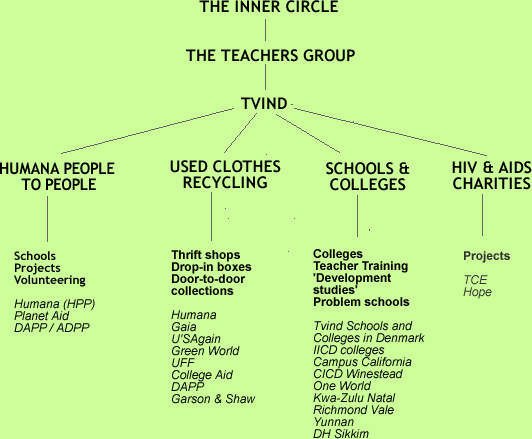
The Teachers Group is not a legal entity. It is however the parent 'charity' that controls dozens of used clothes collection box scheme and volunteering programmes worldwide, especially in Britain, Europe, and the USA.
They include: DAPP UK, Planet AId, Gaia, Humana People to People, and US'Again.
Police and fraud investigators have been investigating the Teachers Group for several years. Its founder and leader, Mogens Amdi Petersen, is currently charged with fraud, but has gone into hiding together with four other top leaders.
Nevertheless, a criminal fraud trial is now (December 2007) under way against one senior Teachers Group member arrested by Danish police. Now read on.
What is the 'Teachers Group'?
Scandinavian in origin, now active behind the scenes all over the world, including the UK and the US, the Teachers Group or 'Tvind' is a group of several hundred individuals who have formally banded together as a co-operative enterprise, with the stated aim of alleviating world poverty and helping bring change to developing countries
It collects used clothes which it sells for the poor in Africa, and runs schools, colleges, Aids/HIV projects and volunteer programmes.
At first glance it is a remarkable ideological achievement. It styles itself as a 'humanitarian movement' and behaves as if it were a mammoth international aid charity. Those who are part of it - thought to be around 600 committed individuals - devote their entire existence to it. A few hard core members, a leadership core of a few dozen, have devoted their whole adult lives to it.
But the Teachers Group is not a straight forward legal entity - there is no obvious head office, chairman, public relations machine, headed notepaper or listing in the telephone book. Oddly, the Teachers Group stays in the background. It acts by proxy, using more than 20 different names, and operating through dozens of apparently unrelated legal entities, charitable trusts and companies. The most famous of these is Humana People-to-People.
There is a very well defined structure to the organisation - there are departments, directors, committees and balance sheets - but they are covert. And it does control things in a highly organised fashion - in Britain, it runs DAPP UK, Planet Aid, Green World, College Aid and CICD. In Europe, its main charities are Humana People-to-People and UFF . And in the United States it is the 'parent company' of Planet Aid, Humana People-to-People, Gaia, and US'Again.
And it is worth a huge amount of money. Together, the 'good causes' promoted by the Teachers Group earn huge sums, receiving annually millions of dollars in donations, clothes, financial support from businesses and, in some countries, large grants from governments, local councils and taxpayers.
The secret side of the Teachers Group
But there is an unknown side to the Teachers Group. This same shadowy movement is also a wealthy and ruthless multinational business. It owns and runs millions of dollars-worth of highly-profitable colonial-style plantations, fruit farms, landholdings and timber companies, property investments, import-export concerns and other businesses
These Teachers Group businesses are financed and controlled from offshore tax havens. They are straight commercial operations, and nothing to do with foreign aid. The Teachers Group also has a financial stake in its own charitable operations. It profits from the properties it uses for its schools, the transport, export and sale of donated used clothes, and even the manufacture of the boxes that are used to collect them.
And here's a remarkable thing: in every single enterprise in this empire, nearly all the directors and senior managers were trained and indoctrinated at the Teachers Group's own training colleges, and are committed members of the small, self-selected and secretive Teachers Group clique, a club that plays by its own rules.
This global enterprise, run by a small group of Teachers using an army of willing volunteers, is often referred to as the 'Tvind empire' (after the Danish name for the movement, Tvind). It is estimated today to be worth $840 million.*
All this is of enormous interest to fraud investigators.
The founder and leader of the Teachers Group, Mogens Amdi Petersen, has been under police investigation for several years. He and five other top Teachers Group leaders have now been charged with fraud and tax evasion in Denmark. All but one of the accused have gone into hiding.
The sixth, a lawyer and businessman named Poul Joergensen, was captured by Danish police, and is currently on trial for fraud in Aarhus, Denmark. His trial started in November 2007 and is still in progress.
Petersen is believed to be living out of the reach of the law in Brazil, Zimbabwe, Mexico or Fiji.
Meanwhile the Teachers Group remains active in more than 30 countries, including The United States, Britain, most of Europe, southern Africa, central America, the Caribbean, India and China.
*Danish police estimate, 2006.
At a glance
About 'Tvind'
Apart from the whiff of scandal, what makes the Teachers Group so interesting? Because it originally began as a radical left wing movement, not a shady cult-like business enterprise.
The Teachers Group is better known as 'Tvind', an alternative educational movement, founded in Denmark in the late 1960s by a group of radical students. Some of the original founders are still involved. Its first school, the Travelling Folk High School, was run on co-operative principles with an emphasis on participatory learning, shared experience, common ownership, and travel to Third World countries.
Originally it was supported by the Danish government - its founder, Mogens Amdi Petersen, had been a Danish school teacher. The name 'Tvind' comes from a small farm deep in the countryside of western Denmark, outside the town of Ulfborg, where it established its first headquarters in 1972.
From early beginnings it expanded to open more schools and a Teacher Training College. It rapidly developed into a Europe-wide movement and acquired its own philosophy, jargon and code of ethics. By the late 1970s it was being compared to a cult or a hard-line political movement. The Danish government withdrew its support and later took steps to prevent public subsidies.
Since then it has expanded across the world and 'diversified' into humanitarian work with volunteer programmes, apparently financed by the collection and sale of second-hand clothes. Volunteer 'development instructors' (DIs) are today trained at colleges in Britain, the United States, India, China, the Caribbean and South Africa. More controversially, Tvind bought enormous agricultural estates in Central and South America and began to amass a huge global property portfolio which has been valued at hundreds of millions of pounds
The Teachers Group in Denmark
The Teachers Group (TG), or in Danish Laeregruppe (LG), is the ideological club of committed, like-minded individuals that drives Tvind. The concept of a 'group' of politically-motivated radical thinkers in solidarity with each other has been around from the very beginning. Members broadly agree that joint endeavour for the goals of the movement is more important than individual achievement.
During its development the Teachers Group became formalised and structured with adherents expected to subscribe to three tenets - common ownership, common economy, and common time. Success as a Tvind student or volunteer was generally accompanied by an invitation to become a 'Teacher', but only providing the principles were strictly accepted and adhered to. Members were invited to pool their incomes in joint bank accounts over which they had no control.
In the 1970s and 1980s life as a Teachers Group member could be extremely harsh. According to many accounts that have emerged in recent years, there were extremes of communal behaviour, with TG members encouraged to mix with each other but not with 'outsiders', refrain from newspapers or watching TV, to abstain from alcohol, and even to inform on each other in cases of 'incorrect thinking'. TG members were told to cut themselves off from parents, brothers and sisters. Sex and relationships even between TG members were definitely not encouraged, and there are a number of well-documented accounts of a TG member's child being conceived and 'adopted' communally, to be brought up in a special school.
Material compensations for 'ordinary' and dedicated TG members are few, but long-serving adherents are offered small tokens - most notoriously, a 'Teachers Group' inscribed watch or fountain pen.
The same spirit of material self-sacrifice does not seem to have applied to every Teacher, however. Testimony by former members, backed up by police evidence, suggests that a powerful inner circle of the Teachers Group has run the group's financial affairs and controlled millions of pounds, some of which may not have been spent in ways ordinary Teachers intended. In the 1990s, tens of millions of dollars that can be traced back to the Teachers Group were lavished on agricultural estates, an investment portfolio, luxury properties and even an ocean-going yacht that were reserved for the use of Mogens Amdi Petersen and a number of selected colleagues.
The membership of the Teachers Group has never numbered more than a few hundred, but its nature, composition and leadership remain shrouded in secrecy. There is every reason to believe, however, that it is still fundamentally run along the same lines and by the same people as it has always been.
<<Back to top More about the Teachers Group >>>
Who is Amdi Petersen?
Amdi Petersen, born 1939, became a hero of the European left when he founded the Tvind school movement in 1968-70. He was a radical school teacher in the Danish city of Odense. In the late 1960s, he threw in his job and embarked with a group of fellow travellers on a tour of the Third World. On their return, the group decided to challenge society by opening an alternative school.
Petersen is charismatic and became an inspiration and natural leader. As time passed, many people came to regard him as a guru of the Tvind movement. A less flattering term often applied to him is 'Svengali-like'. Then, as now, he inspired intense loyalty as well as fear and dislike. Throughout the 1970s he became the undisputed leader of the Teachers Group.
His public association with Tvind ended abruptly in 1979, when he suddenly 'disappeared'. Journalists, the public and most rank and file Tvind supporters outside the inner circle of the Teachers Group were told he had 'retired' abroad. It was not until 22 years later that he re-entered the limelight. In late 2001, following a police investigation, Danish journalists discovered he was living in a $6 million mansion in the Florida millionaire's retreat of Fisher Island, bought with money that could be traced back to the Teachers Group.
In 2002, Petersen was extradited from the USA to Denmark for trial on fraud charges, along with his girlfriend Kirsten Larsen and six other members of the Teachers Group inner circle. The eight are currently on trial charged with $25m fraud and tax evasion in connection with a number of allegedly fake charities. After more than 170 days of evidence, a verdict is due to be delivered by the end of August, 2006.
<<Back to top More about Amdi Petersen >>>
A secret commercial empire
Tvind has been attacked for its politics right from the start, but the true nature of the organisation only became apparent in the 1990s. Tvind may offer great-sounding humanitarian work, but it also runs a huge, allegedly exploitative and certainly very questionable business empire. It makes a large amount of money from property, clothes and farming, and not always in the most ethical fashion - it is often accused of exploiting the very Third World citizens it purports to help.
The Teachers Group began secretly acquiring agricultural estates in the Caribbean and Central America during the 1980s and Teachers were sent out to run them. Today the Teachers group owns some of the biggest mango and banana plantations in the world, in the Cayman Islands, Belize and Ecuador. Conditions for employees on these big plantations are far from enviable: there are frequent reports of workers not being paid and going on strike.
Quite where the money came from to buy all these plantations is a matter of conjecture. However, in at least one case the Danish police have reached firm conclusions. In around 1990, the Teachers Group spent more than £14m on a huge plantation in Brazil, Fazenda Jatoba, which it bought from the oil company Shell. Today, this massive farm is one of the properties at the heart of the current fraud case against Amdi Petersen and the leaders of the Teachers Group. The police allege much of the money used to buy the estate was money donated for humanitarian work in good faith by ordinary Teachers Group members, siphoned through a series of bogus charities and nominee accounts.
The money-go-round
Tvind is often labelled by its critics a 'money machine'. One of the most striking aspects of the so-called 'Tvind Empire' is the incredible number of interlinked companies, businesses, trust funds, offshore accounts and nominee companies in overseas tax havens that can easily be traced back to Tvind. In most cases, they are run by boards composed entirely of individual Teachers Group members.
The Danish police investigation of 1999-2002 turned up one compelling constellation of linked companies and funds, many in far flung places such as the Cayman Islands, Borneo, Hong Kong and Brazil, run by Teachers Group members. The police case is that millions of pounds were illegally transferred around these companies and to and from large accounts in London and Denmark, on the direction of a small inner circle of the Teachers Group, to support non-charitable enterprises and avoid tax. Many of those TG members are now facing fraud charges.
While some accounts and trust funds in Denmark have been rolled up, many offshore accounts and nominee companies still exist, in places such as Jersey, Guernsey, Gibraltar and the Isle of Man. Nobody knows their true purpose.
Tvind is, in fact, a financial merry-go round. Behind every Tvind enterprise is a Teachers Group company. Why? A look at the big picture suggests Tvind has developed a unique economic system to recirculate and concentrate money within the organisation - a conclusion supported by several studies and newspaper investigations in Scandinavia, England and North America. Very clever. The work of a genius, actually.
<<Back to top More about the money-go-round>>>
Luxuries for the inner circle
With all this money sloshing about, it is no surprise that some of it may have been used to go shopping. And not necessarily for fair trade tea and coffee for the development instructors.
When the fugitive Amdi Petersen was tracked down to Miami, reporters from the Danish newspaper Jyllands Posten found he had been enjoying a life of almost obscene luxury for ten years. The $6m penthouse apartment at 5302 Fisher Island Drive, apparently bought through a nominee company by the Teachers Group, was at the heart of one of the most exclusive residential areas in the United states - a 'millionaire's playground'. Outside was a golf club with fees of hundreds of thousands of dollars. Petersen was a member. So was his girlfriend, Kirsten Larsen
The apartment had recently been refurbished by the noted interior designer X for a cost of X million. A few yards away was a second, similar apartment - for their dog.
Also at the disposal of the inner circle of the Teachers group was X foot luxury ocean-going yacht, the Butterfly McQueen. These were not the only luxury properties associated with the TG - there had also been a beachside villa on the Caymans, a well-appointed residence with a private zoo in Zimbabwe, and plans for a 'retirement home' in Fiji. At the time of writing, Petersen lives in a high security villa with private swimming pool and indoor tennis court in Denmark.
<<Back to top More about the money-go-round>>>
The fraud trial 2003-2006
In early 2001, prompted by a Danish TV documentary and evidence from informants, Danish police mounted a simultaneous early morning raid on seven Teachers Group properties in Denmark. They took away documents and a large number of computers. Several months later, the FBI arrested Mogens Amdi Petersen at Los Angeles international airport and he was held pending extradition.
The Danish computer files were encrypted but, despite a marked lack of cooperation from Tvind, the police eventually succeeded in unlocking them. They contained, according to the Danish office of serious financial crime, tens of thousands of pages of financial records going back many years. On the basis of the information, Petersen, now extradited to Denmark, and seven other leading Teachers Group leaders were charged with fraud and tax evasion.
Police say there were so many pages of accounts they were unable to investigate every one. They chose to concentrate on the Humanitarian Foundation, a wealthy Tvind trust fund set up in Denmark in the 1980s with long-term finance from rank and file TG members. The fund was supposed to benefit environmental projects in the Third World, such as a biomass project in Fiji, a forest reserve in Borneo and a 'green' power plant in Brazil, as well as humanitarian projects.
The fraud case has turned out to be the longest, most complicated and most expensive ever held in Denmark, with evidence and legal arguments over more than 170 days. In essence, the police allege there was a kind of conspiracy among the most senior Teachers Group leaders to divert money away from genuine environmental work into a network of front companies, bogus charities and offshore accounts, under the noses of ordinary TG members. The forest reserve was really a sawmill, for example, while the biomass and green energy projects never existed, police say.
The eight defendants and their supporters in the Teachers group have strongly refuted these allegations, issuing strongly worded statements in their defence, and counter claiming that the trial is a politically-motivated attempt to smash the Tvind movement. Prosecutors have called for jail sentences of between three and five years for the leaders if found guilty. A verdict is expected by the end of August, 2006.
<<Back to top More about the money-go-round>>>
The unfolding story 1977-2006
Much of what is now known in detail about the 'inside story' of Humana People-to-People, Tvind and the Teachers Group has emerged only in the last five years. In truth, though, the story has gradually been unfolding ever since the Travelling Folk High School was founded in 1969, if only one had been able to recognise it.
The first book to be highly critical of Tvind was published as long ago as 1979, suggesting that the school system was a kind of Stalinist cult. Over the following years, Tvind schools and volunteering projects have rarely been out of the news in Denmark or other parts of the world, as scandal after scandal has rocked the growing 'empire'.
In the early days, there were many concerns about Humana's safety, especially over its policy of making volunteers hitch hike around Africa and Europe. In the early 1980s, three young Teachers on a Tvind-owned vessel drowned in an accident at sea in the English Channel. With great regularity, hundreds of volunteers have sounded alarm bells at Humana's methods of street fundraising, sleeping in church halls or strangers' front rooms.
Later attention began to be directed at Humana's finances and charity programmes, with investigative articles in various newspapers. The Danish government took legal advice and changed its constitution to prevent the Tvind schools receiving public subsidies under Denmark's liberal education laws. In Britain in 1997-9, the UK charity regulator The Charity Commission shut down Humana UK and two Tvind small schools after an investigation. In the United States, the State of Virginia closed down Aka Pecha school, and in France Humana ceased operating after the French government declared it a cult and imposed heavy tax revenues.
<<Back to top More about the Humana story 1977-2006>>>
Is Tvind a cult?
The short answer is - yes. Almost certainly. According to many experts, Tvind and the Teachers group display many of the characteristics of what is known as 'top-down' cult.
These include: an all-powerful and charismatic 'guru'; a heirarchical structure; a sense of being separate from the rest of society; an idealistic (but probably unachievable) 'mission'; distance from family, parents and loved ones; a private 'language' and lots of jargon; strict discipline; the setting of unrealistic targets; overwork (or sleep or nutritional deprivation); lack of personal space and privacy; a private 'language' and lots of jargon; and a tendency to recruit young, clever, single people looking for a sense of identity.
In the Teachers Group and Tvind, no bizarre sex (but see here), no spaceships or aliens, no human sacrifice or witchcraft - just lots of meetings, meetings, meetings. And there have been many allegations of 'brainwashing', 'mind control' and 'psychological manipulation'.
Of course, many organisations - from the Roman Catholic Church to a large Wall Street brokerage firm - might be said to have many of the same characteristics. Nevertheless, many cult information groups and 'deprogrammers' list information on Humana and Tvind on their public websites.
<<Back to top More on Is it a cult? >>>
Our sources
We are not alone. We were not even the first. Dozens and dozens of books, articles, official reports, radio programmes, television documentaries and even a short film have been produced on Tvind and the Teachers Group since 1968. Unfortunately many of these sources are in Danish, but have assembled a library of material, most translated into English, here.
We have drawn much unique material from eyewitness accounts, personal statements, emails, letters and academic research sent direct to us. Some of us have carried out or own interviews and on the spot in Denmark, Zimbabwe, Britain, Holland and the United States.
Two outstanding contributions to the Tvind story deserve particular mention: journalism student Leif Gunnar Lie's 1999 Thesis on Tvind (here reproduced with permission), and ex-Teacher Steen Thomsen's statement on his 26 years in the Teachers Group.
<<Back to top More about our sources >>>
Links
No site would be complete without links, and here we list web pages with information relevant to the Humana-Tvind story, or which link to us. We will also attempt to maintain an up-to-date list of Tvind's many web sites, as far as we are able.
We are often asked to recommend alternative volunteer agencies in Britain or the United States. We don't recommend any particular agency, but here is a list of some volunteering organisations that, as far as we know, are reputable, reliable and not a rip-off.
Please link to us. To send us a link, please email your website address.
<<Back to top More about our web links>>>
How to contact us
Email contact@humana-alert.com
<<Back to top More about us>>>
Sponsor us
Please help us with financial support by making a contribution to our running costs.
If you would like to advertise or become a site sponsor, please email us
Press inquiries
Initially please send an email to: contact@humana-alert.com
<<Back to top More about media enquiries>>>
It collects used clothes which it sells for the poor in Africa, and runs schools, colleges, Aids/HIV projects and volunteer programmes.
At first glance it is a remarkable ideological achievement. It styles itself as a 'humanitarian movement' and behaves as if it were a mammoth international aid charity. Those who are part of it - thought to be around 600 committed individuals - devote their entire existence to it. A few hard core members, a leadership core of a few dozen, have devoted their whole adult lives to it.
But the Teachers Group is not a straight forward legal entity - there is no obvious head office, chairman, public relations machine, headed notepaper or listing in the telephone book. Oddly, the Teachers Group stays in the background. It acts by proxy, using more than 20 different names, and operating through dozens of apparently unrelated legal entities, charitable trusts and companies. The most famous of these is Humana People-to-People.
There is a very well defined structure to the organisation - there are departments, directors, committees and balance sheets - but they are covert. And it does control things in a highly organised fashion - in Britain, it runs DAPP UK, Planet Aid, Green World, College Aid and CICD. In Europe, its main charities are Humana People-to-People and UFF . And in the United States it is the 'parent company' of Planet Aid, Humana People-to-People, Gaia, and US'Again.
And it is worth a huge amount of money. Together, the 'good causes' promoted by the Teachers Group earn huge sums, receiving annually millions of dollars in donations, clothes, financial support from businesses and, in some countries, large grants from governments, local councils and taxpayers.
The secret side of the Teachers Group
But there is an unknown side to the Teachers Group. This same shadowy movement is also a wealthy and ruthless multinational business. It owns and runs millions of dollars-worth of highly-profitable colonial-style plantations, fruit farms, landholdings and timber companies, property investments, import-export concerns and other businesses
These Teachers Group businesses are financed and controlled from offshore tax havens. They are straight commercial operations, and nothing to do with foreign aid. The Teachers Group also has a financial stake in its own charitable operations. It profits from the properties it uses for its schools, the transport, export and sale of donated used clothes, and even the manufacture of the boxes that are used to collect them.
And here's a remarkable thing: in every single enterprise in this empire, nearly all the directors and senior managers were trained and indoctrinated at the Teachers Group's own training colleges, and are committed members of the small, self-selected and secretive Teachers Group clique, a club that plays by its own rules.
This global enterprise, run by a small group of Teachers using an army of willing volunteers, is often referred to as the 'Tvind empire' (after the Danish name for the movement, Tvind). It is estimated today to be worth $840 million.*
All this is of enormous interest to fraud investigators.
The founder and leader of the Teachers Group, Mogens Amdi Petersen, has been under police investigation for several years. He and five other top Teachers Group leaders have now been charged with fraud and tax evasion in Denmark. All but one of the accused have gone into hiding.
The sixth, a lawyer and businessman named Poul Joergensen, was captured by Danish police, and is currently on trial for fraud in Aarhus, Denmark. His trial started in November 2007 and is still in progress.
Petersen is believed to be living out of the reach of the law in Brazil, Zimbabwe, Mexico or Fiji.
Meanwhile the Teachers Group remains active in more than 30 countries, including The United States, Britain, most of Europe, southern Africa, central America, the Caribbean, India and China.
*Danish police estimate, 2006.
At a glance
About 'Tvind'
Apart from the whiff of scandal, what makes the Teachers Group so interesting? Because it originally began as a radical left wing movement, not a shady cult-like business enterprise.
The Teachers Group is better known as 'Tvind', an alternative educational movement, founded in Denmark in the late 1960s by a group of radical students. Some of the original founders are still involved. Its first school, the Travelling Folk High School, was run on co-operative principles with an emphasis on participatory learning, shared experience, common ownership, and travel to Third World countries.
Originally it was supported by the Danish government - its founder, Mogens Amdi Petersen, had been a Danish school teacher. The name 'Tvind' comes from a small farm deep in the countryside of western Denmark, outside the town of Ulfborg, where it established its first headquarters in 1972.
From early beginnings it expanded to open more schools and a Teacher Training College. It rapidly developed into a Europe-wide movement and acquired its own philosophy, jargon and code of ethics. By the late 1970s it was being compared to a cult or a hard-line political movement. The Danish government withdrew its support and later took steps to prevent public subsidies.
Since then it has expanded across the world and 'diversified' into humanitarian work with volunteer programmes, apparently financed by the collection and sale of second-hand clothes. Volunteer 'development instructors' (DIs) are today trained at colleges in Britain, the United States, India, China, the Caribbean and South Africa. More controversially, Tvind bought enormous agricultural estates in Central and South America and began to amass a huge global property portfolio which has been valued at hundreds of millions of pounds
The Teachers Group in Denmark
The Teachers Group (TG), or in Danish Laeregruppe (LG), is the ideological club of committed, like-minded individuals that drives Tvind. The concept of a 'group' of politically-motivated radical thinkers in solidarity with each other has been around from the very beginning. Members broadly agree that joint endeavour for the goals of the movement is more important than individual achievement.
During its development the Teachers Group became formalised and structured with adherents expected to subscribe to three tenets - common ownership, common economy, and common time. Success as a Tvind student or volunteer was generally accompanied by an invitation to become a 'Teacher', but only providing the principles were strictly accepted and adhered to. Members were invited to pool their incomes in joint bank accounts over which they had no control.
In the 1970s and 1980s life as a Teachers Group member could be extremely harsh. According to many accounts that have emerged in recent years, there were extremes of communal behaviour, with TG members encouraged to mix with each other but not with 'outsiders', refrain from newspapers or watching TV, to abstain from alcohol, and even to inform on each other in cases of 'incorrect thinking'. TG members were told to cut themselves off from parents, brothers and sisters. Sex and relationships even between TG members were definitely not encouraged, and there are a number of well-documented accounts of a TG member's child being conceived and 'adopted' communally, to be brought up in a special school.
Material compensations for 'ordinary' and dedicated TG members are few, but long-serving adherents are offered small tokens - most notoriously, a 'Teachers Group' inscribed watch or fountain pen.
The same spirit of material self-sacrifice does not seem to have applied to every Teacher, however. Testimony by former members, backed up by police evidence, suggests that a powerful inner circle of the Teachers Group has run the group's financial affairs and controlled millions of pounds, some of which may not have been spent in ways ordinary Teachers intended. In the 1990s, tens of millions of dollars that can be traced back to the Teachers Group were lavished on agricultural estates, an investment portfolio, luxury properties and even an ocean-going yacht that were reserved for the use of Mogens Amdi Petersen and a number of selected colleagues.
The membership of the Teachers Group has never numbered more than a few hundred, but its nature, composition and leadership remain shrouded in secrecy. There is every reason to believe, however, that it is still fundamentally run along the same lines and by the same people as it has always been.
<<Back to top More about the Teachers Group >>>
Who is Amdi Petersen?
Amdi Petersen, born 1939, became a hero of the European left when he founded the Tvind school movement in 1968-70. He was a radical school teacher in the Danish city of Odense. In the late 1960s, he threw in his job and embarked with a group of fellow travellers on a tour of the Third World. On their return, the group decided to challenge society by opening an alternative school.
Petersen is charismatic and became an inspiration and natural leader. As time passed, many people came to regard him as a guru of the Tvind movement. A less flattering term often applied to him is 'Svengali-like'. Then, as now, he inspired intense loyalty as well as fear and dislike. Throughout the 1970s he became the undisputed leader of the Teachers Group.
His public association with Tvind ended abruptly in 1979, when he suddenly 'disappeared'. Journalists, the public and most rank and file Tvind supporters outside the inner circle of the Teachers Group were told he had 'retired' abroad. It was not until 22 years later that he re-entered the limelight. In late 2001, following a police investigation, Danish journalists discovered he was living in a $6 million mansion in the Florida millionaire's retreat of Fisher Island, bought with money that could be traced back to the Teachers Group.
In 2002, Petersen was extradited from the USA to Denmark for trial on fraud charges, along with his girlfriend Kirsten Larsen and six other members of the Teachers Group inner circle. The eight are currently on trial charged with $25m fraud and tax evasion in connection with a number of allegedly fake charities. After more than 170 days of evidence, a verdict is due to be delivered by the end of August, 2006.
<<Back to top More about Amdi Petersen >>>
A secret commercial empire
Tvind has been attacked for its politics right from the start, but the true nature of the organisation only became apparent in the 1990s. Tvind may offer great-sounding humanitarian work, but it also runs a huge, allegedly exploitative and certainly very questionable business empire. It makes a large amount of money from property, clothes and farming, and not always in the most ethical fashion - it is often accused of exploiting the very Third World citizens it purports to help.
The Teachers Group began secretly acquiring agricultural estates in the Caribbean and Central America during the 1980s and Teachers were sent out to run them. Today the Teachers group owns some of the biggest mango and banana plantations in the world, in the Cayman Islands, Belize and Ecuador. Conditions for employees on these big plantations are far from enviable: there are frequent reports of workers not being paid and going on strike.
Quite where the money came from to buy all these plantations is a matter of conjecture. However, in at least one case the Danish police have reached firm conclusions. In around 1990, the Teachers Group spent more than £14m on a huge plantation in Brazil, Fazenda Jatoba, which it bought from the oil company Shell. Today, this massive farm is one of the properties at the heart of the current fraud case against Amdi Petersen and the leaders of the Teachers Group. The police allege much of the money used to buy the estate was money donated for humanitarian work in good faith by ordinary Teachers Group members, siphoned through a series of bogus charities and nominee accounts.
The money-go-round
Tvind is often labelled by its critics a 'money machine'. One of the most striking aspects of the so-called 'Tvind Empire' is the incredible number of interlinked companies, businesses, trust funds, offshore accounts and nominee companies in overseas tax havens that can easily be traced back to Tvind. In most cases, they are run by boards composed entirely of individual Teachers Group members.
The Danish police investigation of 1999-2002 turned up one compelling constellation of linked companies and funds, many in far flung places such as the Cayman Islands, Borneo, Hong Kong and Brazil, run by Teachers Group members. The police case is that millions of pounds were illegally transferred around these companies and to and from large accounts in London and Denmark, on the direction of a small inner circle of the Teachers Group, to support non-charitable enterprises and avoid tax. Many of those TG members are now facing fraud charges.
While some accounts and trust funds in Denmark have been rolled up, many offshore accounts and nominee companies still exist, in places such as Jersey, Guernsey, Gibraltar and the Isle of Man. Nobody knows their true purpose.
Tvind is, in fact, a financial merry-go round. Behind every Tvind enterprise is a Teachers Group company. Why? A look at the big picture suggests Tvind has developed a unique economic system to recirculate and concentrate money within the organisation - a conclusion supported by several studies and newspaper investigations in Scandinavia, England and North America. Very clever. The work of a genius, actually.
<<Back to top More about the money-go-round>>>
Luxuries for the inner circle
With all this money sloshing about, it is no surprise that some of it may have been used to go shopping. And not necessarily for fair trade tea and coffee for the development instructors.
When the fugitive Amdi Petersen was tracked down to Miami, reporters from the Danish newspaper Jyllands Posten found he had been enjoying a life of almost obscene luxury for ten years. The $6m penthouse apartment at 5302 Fisher Island Drive, apparently bought through a nominee company by the Teachers Group, was at the heart of one of the most exclusive residential areas in the United states - a 'millionaire's playground'. Outside was a golf club with fees of hundreds of thousands of dollars. Petersen was a member. So was his girlfriend, Kirsten Larsen
The apartment had recently been refurbished by the noted interior designer X for a cost of X million. A few yards away was a second, similar apartment - for their dog.
Also at the disposal of the inner circle of the Teachers group was X foot luxury ocean-going yacht, the Butterfly McQueen. These were not the only luxury properties associated with the TG - there had also been a beachside villa on the Caymans, a well-appointed residence with a private zoo in Zimbabwe, and plans for a 'retirement home' in Fiji. At the time of writing, Petersen lives in a high security villa with private swimming pool and indoor tennis court in Denmark.
<<Back to top More about the money-go-round>>>
The fraud trial 2003-2006
In early 2001, prompted by a Danish TV documentary and evidence from informants, Danish police mounted a simultaneous early morning raid on seven Teachers Group properties in Denmark. They took away documents and a large number of computers. Several months later, the FBI arrested Mogens Amdi Petersen at Los Angeles international airport and he was held pending extradition.
The Danish computer files were encrypted but, despite a marked lack of cooperation from Tvind, the police eventually succeeded in unlocking them. They contained, according to the Danish office of serious financial crime, tens of thousands of pages of financial records going back many years. On the basis of the information, Petersen, now extradited to Denmark, and seven other leading Teachers Group leaders were charged with fraud and tax evasion.
Police say there were so many pages of accounts they were unable to investigate every one. They chose to concentrate on the Humanitarian Foundation, a wealthy Tvind trust fund set up in Denmark in the 1980s with long-term finance from rank and file TG members. The fund was supposed to benefit environmental projects in the Third World, such as a biomass project in Fiji, a forest reserve in Borneo and a 'green' power plant in Brazil, as well as humanitarian projects.
The fraud case has turned out to be the longest, most complicated and most expensive ever held in Denmark, with evidence and legal arguments over more than 170 days. In essence, the police allege there was a kind of conspiracy among the most senior Teachers Group leaders to divert money away from genuine environmental work into a network of front companies, bogus charities and offshore accounts, under the noses of ordinary TG members. The forest reserve was really a sawmill, for example, while the biomass and green energy projects never existed, police say.
The eight defendants and their supporters in the Teachers group have strongly refuted these allegations, issuing strongly worded statements in their defence, and counter claiming that the trial is a politically-motivated attempt to smash the Tvind movement. Prosecutors have called for jail sentences of between three and five years for the leaders if found guilty. A verdict is expected by the end of August, 2006.
<<Back to top More about the money-go-round>>>
The unfolding story 1977-2006
Much of what is now known in detail about the 'inside story' of Humana People-to-People, Tvind and the Teachers Group has emerged only in the last five years. In truth, though, the story has gradually been unfolding ever since the Travelling Folk High School was founded in 1969, if only one had been able to recognise it.
The first book to be highly critical of Tvind was published as long ago as 1979, suggesting that the school system was a kind of Stalinist cult. Over the following years, Tvind schools and volunteering projects have rarely been out of the news in Denmark or other parts of the world, as scandal after scandal has rocked the growing 'empire'.
In the early days, there were many concerns about Humana's safety, especially over its policy of making volunteers hitch hike around Africa and Europe. In the early 1980s, three young Teachers on a Tvind-owned vessel drowned in an accident at sea in the English Channel. With great regularity, hundreds of volunteers have sounded alarm bells at Humana's methods of street fundraising, sleeping in church halls or strangers' front rooms.
Later attention began to be directed at Humana's finances and charity programmes, with investigative articles in various newspapers. The Danish government took legal advice and changed its constitution to prevent the Tvind schools receiving public subsidies under Denmark's liberal education laws. In Britain in 1997-9, the UK charity regulator The Charity Commission shut down Humana UK and two Tvind small schools after an investigation. In the United States, the State of Virginia closed down Aka Pecha school, and in France Humana ceased operating after the French government declared it a cult and imposed heavy tax revenues.
<<Back to top More about the Humana story 1977-2006>>>
Is Tvind a cult?
The short answer is - yes. Almost certainly. According to many experts, Tvind and the Teachers group display many of the characteristics of what is known as 'top-down' cult.
These include: an all-powerful and charismatic 'guru'; a heirarchical structure; a sense of being separate from the rest of society; an idealistic (but probably unachievable) 'mission'; distance from family, parents and loved ones; a private 'language' and lots of jargon; strict discipline; the setting of unrealistic targets; overwork (or sleep or nutritional deprivation); lack of personal space and privacy; a private 'language' and lots of jargon; and a tendency to recruit young, clever, single people looking for a sense of identity.
In the Teachers Group and Tvind, no bizarre sex (but see here), no spaceships or aliens, no human sacrifice or witchcraft - just lots of meetings, meetings, meetings. And there have been many allegations of 'brainwashing', 'mind control' and 'psychological manipulation'.
Of course, many organisations - from the Roman Catholic Church to a large Wall Street brokerage firm - might be said to have many of the same characteristics. Nevertheless, many cult information groups and 'deprogrammers' list information on Humana and Tvind on their public websites.
<<Back to top More on Is it a cult? >>>
Our sources
We are not alone. We were not even the first. Dozens and dozens of books, articles, official reports, radio programmes, television documentaries and even a short film have been produced on Tvind and the Teachers Group since 1968. Unfortunately many of these sources are in Danish, but have assembled a library of material, most translated into English, here.
We have drawn much unique material from eyewitness accounts, personal statements, emails, letters and academic research sent direct to us. Some of us have carried out or own interviews and on the spot in Denmark, Zimbabwe, Britain, Holland and the United States.
Two outstanding contributions to the Tvind story deserve particular mention: journalism student Leif Gunnar Lie's 1999 Thesis on Tvind (here reproduced with permission), and ex-Teacher Steen Thomsen's statement on his 26 years in the Teachers Group.
<<Back to top More about our sources >>>
Links
No site would be complete without links, and here we list web pages with information relevant to the Humana-Tvind story, or which link to us. We will also attempt to maintain an up-to-date list of Tvind's many web sites, as far as we are able.
We are often asked to recommend alternative volunteer agencies in Britain or the United States. We don't recommend any particular agency, but here is a list of some volunteering organisations that, as far as we know, are reputable, reliable and not a rip-off.
Please link to us. To send us a link, please email your website address.
<<Back to top More about our web links>>>
How to contact us
Email contact@humana-alert.com
<<Back to top More about us>>>
Sponsor us
Please help us with financial support by making a contribution to our running costs.
If you would like to advertise or become a site sponsor, please email us
Press inquiries
Initially please send an email to: contact@humana-alert.com
<<Back to top More about media enquiries>>>
At first glance it is a remarkable ideological achievement. It styles itself as a 'humanitarian movement' and behaves as if it were a mammoth international aid charity. Those who are part of it - thought to be around 600 committed individuals - devote their entire existence to it. A few hard core members, a leadership core of a few dozen, have devoted their whole adult lives to it.
But the Teachers Group is not a straight forward legal entity - there is no obvious head office, chairman, public relations machine, headed notepaper or listing in the telephone book. Oddly, the Teachers Group stays in the background. It acts by proxy, using more than 20 different names, and operating through dozens of apparently unrelated legal entities, charitable trusts and companies. The most famous of these is Humana People-to-People.
There is a very well defined structure to the organisation - there are departments, directors, committees and balance sheets - but they are covert. And it does control things in a highly organised fashion - in Britain, it runs DAPP UK, Planet Aid, Green World, College Aid and CICD. In Europe, its main charities are Humana People-to-People and UFF . And in the United States it is the 'parent company' of Planet Aid, Humana People-to-People, Gaia, and US'Again.
And it is worth a huge amount of money. Together, the 'good causes' promoted by the Teachers Group earn huge sums, receiving annually millions of dollars in donations, clothes, financial support from businesses and, in some countries, large grants from governments, local councils and taxpayers.
The secret side of the Teachers Group
But there is an unknown side to the Teachers Group. This same shadowy movement is also a wealthy and ruthless multinational business. It owns and runs millions of dollars-worth of highly-profitable colonial-style plantations, fruit farms, landholdings and timber companies, property investments, import-export concerns and other businesses
These Teachers Group businesses are financed and controlled from offshore tax havens. They are straight commercial operations, and nothing to do with foreign aid. The Teachers Group also has a financial stake in its own charitable operations. It profits from the properties it uses for its schools, the transport, export and sale of donated used clothes, and even the manufacture of the boxes that are used to collect them.
And here's a remarkable thing: in every single enterprise in this empire, nearly all the directors and senior managers were trained and indoctrinated at the Teachers Group's own training colleges, and are committed members of the small, self-selected and secretive Teachers Group clique, a club that plays by its own rules.
This global enterprise, run by a small group of Teachers using an army of willing volunteers, is often referred to as the 'Tvind empire' (after the Danish name for the movement, Tvind). It is estimated today to be worth $840 million.*
All this is of enormous interest to fraud investigators.
The founder and leader of the Teachers Group, Mogens Amdi Petersen, has been under police investigation for several years. He and five other top Teachers Group leaders have now been charged with fraud and tax evasion in Denmark. All but one of the accused have gone into hiding.
The sixth, a lawyer and businessman named Poul Joergensen, was captured by Danish police, and is currently on trial for fraud in Aarhus, Denmark. His trial started in November 2007 and is still in progress.
Petersen is believed to be living out of the reach of the law in Brazil, Zimbabwe, Mexico or Fiji.
Meanwhile the Teachers Group remains active in more than 30 countries, including The United States, Britain, most of Europe, southern Africa, central America, the Caribbean, India and China.
*Danish police estimate, 2006.
Apart from the whiff of scandal, what makes the Teachers Group so interesting? Because it originally began as a radical left wing movement, not a shady cult-like business enterprise.
The Teachers Group is better known as 'Tvind', an alternative educational movement, founded in Denmark in the late 1960s by a group of radical students. Some of the original founders are still involved. Its first school, the Travelling Folk High School, was run on co-operative principles with an emphasis on participatory learning, shared experience, common ownership, and travel to Third World countries.
Originally it was supported by the Danish government - its founder, Mogens Amdi Petersen, had been a Danish school teacher. The name 'Tvind' comes from a small farm deep in the countryside of western Denmark, outside the town of Ulfborg, where it established its first headquarters in 1972.
From early beginnings it expanded to open more schools and a Teacher Training College. It rapidly developed into a Europe-wide movement and acquired its own philosophy, jargon and code of ethics. By the late 1970s it was being compared to a cult or a hard-line political movement. The Danish government withdrew its support and later took steps to prevent public subsidies.
Since then it has expanded across the world and 'diversified' into humanitarian work with volunteer programmes, apparently financed by the collection and sale of second-hand clothes. Volunteer 'development instructors' (DIs) are today trained at colleges in Britain, the United States, India, China, the Caribbean and South Africa. More controversially, Tvind bought enormous agricultural estates in Central and South America and began to amass a huge global property portfolio which has been valued at hundreds of millions of pounds
The Teachers Group in Denmark
The Teachers Group (TG), or in Danish Laeregruppe (LG), is the ideological club of committed, like-minded individuals that drives Tvind. The concept of a 'group' of politically-motivated radical thinkers in solidarity with each other has been around from the very beginning. Members broadly agree that joint endeavour for the goals of the movement is more important than individual achievement.
During its development the Teachers Group became formalised and structured with adherents expected to subscribe to three tenets - common ownership, common economy, and common time. Success as a Tvind student or volunteer was generally accompanied by an invitation to become a 'Teacher', but only providing the principles were strictly accepted and adhered to. Members were invited to pool their incomes in joint bank accounts over which they had no control.
In the 1970s and 1980s life as a Teachers Group member could be extremely harsh. According to many accounts that have emerged in recent years, there were extremes of communal behaviour, with TG members encouraged to mix with each other but not with 'outsiders', refrain from newspapers or watching TV, to abstain from alcohol, and even to inform on each other in cases of 'incorrect thinking'. TG members were told to cut themselves off from parents, brothers and sisters. Sex and relationships even between TG members were definitely not encouraged, and there are a number of well-documented accounts of a TG member's child being conceived and 'adopted' communally, to be brought up in a special school.
Material compensations for 'ordinary' and dedicated TG members are few, but long-serving adherents are offered small tokens - most notoriously, a 'Teachers Group' inscribed watch or fountain pen.
The same spirit of material self-sacrifice does not seem to have applied to every Teacher, however. Testimony by former members, backed up by police evidence, suggests that a powerful inner circle of the Teachers Group has run the group's financial affairs and controlled millions of pounds, some of which may not have been spent in ways ordinary Teachers intended. In the 1990s, tens of millions of dollars that can be traced back to the Teachers Group were lavished on agricultural estates, an investment portfolio, luxury properties and even an ocean-going yacht that were reserved for the use of Mogens Amdi Petersen and a number of selected colleagues.
The membership of the Teachers Group has never numbered more than a few hundred, but its nature, composition and leadership remain shrouded in secrecy. There is every reason to believe, however, that it is still fundamentally run along the same lines and by the same people as it has always been.
<<Back to top More about the Teachers Group >>>
Who is Amdi Petersen?
Amdi Petersen, born 1939, became a hero of the European left when he founded the Tvind school movement in 1968-70. He was a radical school teacher in the Danish city of Odense. In the late 1960s, he threw in his job and embarked with a group of fellow travellers on a tour of the Third World. On their return, the group decided to challenge society by opening an alternative school.
Petersen is charismatic and became an inspiration and natural leader. As time passed, many people came to regard him as a guru of the Tvind movement. A less flattering term often applied to him is 'Svengali-like'. Then, as now, he inspired intense loyalty as well as fear and dislike. Throughout the 1970s he became the undisputed leader of the Teachers Group.
His public association with Tvind ended abruptly in 1979, when he suddenly 'disappeared'. Journalists, the public and most rank and file Tvind supporters outside the inner circle of the Teachers Group were told he had 'retired' abroad. It was not until 22 years later that he re-entered the limelight. In late 2001, following a police investigation, Danish journalists discovered he was living in a $6 million mansion in the Florida millionaire's retreat of Fisher Island, bought with money that could be traced back to the Teachers Group.
In 2002, Petersen was extradited from the USA to Denmark for trial on fraud charges, along with his girlfriend Kirsten Larsen and six other members of the Teachers Group inner circle. The eight are currently on trial charged with $25m fraud and tax evasion in connection with a number of allegedly fake charities. After more than 170 days of evidence, a verdict is due to be delivered by the end of August, 2006.
<<Back to top More about Amdi Petersen >>>
A secret commercial empire
Tvind has been attacked for its politics right from the start, but the true nature of the organisation only became apparent in the 1990s. Tvind may offer great-sounding humanitarian work, but it also runs a huge, allegedly exploitative and certainly very questionable business empire. It makes a large amount of money from property, clothes and farming, and not always in the most ethical fashion - it is often accused of exploiting the very Third World citizens it purports to help.
The Teachers Group began secretly acquiring agricultural estates in the Caribbean and Central America during the 1980s and Teachers were sent out to run them. Today the Teachers group owns some of the biggest mango and banana plantations in the world, in the Cayman Islands, Belize and Ecuador. Conditions for employees on these big plantations are far from enviable: there are frequent reports of workers not being paid and going on strike.
Quite where the money came from to buy all these plantations is a matter of conjecture. However, in at least one case the Danish police have reached firm conclusions. In around 1990, the Teachers Group spent more than £14m on a huge plantation in Brazil, Fazenda Jatoba, which it bought from the oil company Shell. Today, this massive farm is one of the properties at the heart of the current fraud case against Amdi Petersen and the leaders of the Teachers Group. The police allege much of the money used to buy the estate was money donated for humanitarian work in good faith by ordinary Teachers Group members, siphoned through a series of bogus charities and nominee accounts.
The money-go-round
Tvind is often labelled by its critics a 'money machine'. One of the most striking aspects of the so-called 'Tvind Empire' is the incredible number of interlinked companies, businesses, trust funds, offshore accounts and nominee companies in overseas tax havens that can easily be traced back to Tvind. In most cases, they are run by boards composed entirely of individual Teachers Group members.
The Danish police investigation of 1999-2002 turned up one compelling constellation of linked companies and funds, many in far flung places such as the Cayman Islands, Borneo, Hong Kong and Brazil, run by Teachers Group members. The police case is that millions of pounds were illegally transferred around these companies and to and from large accounts in London and Denmark, on the direction of a small inner circle of the Teachers Group, to support non-charitable enterprises and avoid tax. Many of those TG members are now facing fraud charges.
While some accounts and trust funds in Denmark have been rolled up, many offshore accounts and nominee companies still exist, in places such as Jersey, Guernsey, Gibraltar and the Isle of Man. Nobody knows their true purpose.
Tvind is, in fact, a financial merry-go round. Behind every Tvind enterprise is a Teachers Group company. Why? A look at the big picture suggests Tvind has developed a unique economic system to recirculate and concentrate money within the organisation - a conclusion supported by several studies and newspaper investigations in Scandinavia, England and North America. Very clever. The work of a genius, actually.
<<Back to top More about the money-go-round>>>
Luxuries for the inner circle
With all this money sloshing about, it is no surprise that some of it may have been used to go shopping. And not necessarily for fair trade tea and coffee for the development instructors.
When the fugitive Amdi Petersen was tracked down to Miami, reporters from the Danish newspaper Jyllands Posten found he had been enjoying a life of almost obscene luxury for ten years. The $6m penthouse apartment at 5302 Fisher Island Drive, apparently bought through a nominee company by the Teachers Group, was at the heart of one of the most exclusive residential areas in the United states - a 'millionaire's playground'. Outside was a golf club with fees of hundreds of thousands of dollars. Petersen was a member. So was his girlfriend, Kirsten Larsen
The apartment had recently been refurbished by the noted interior designer X for a cost of X million. A few yards away was a second, similar apartment - for their dog.
Also at the disposal of the inner circle of the Teachers group was X foot luxury ocean-going yacht, the Butterfly McQueen. These were not the only luxury properties associated with the TG - there had also been a beachside villa on the Caymans, a well-appointed residence with a private zoo in Zimbabwe, and plans for a 'retirement home' in Fiji. At the time of writing, Petersen lives in a high security villa with private swimming pool and indoor tennis court in Denmark.
<<Back to top More about the money-go-round>>>
The fraud trial 2003-2006
In early 2001, prompted by a Danish TV documentary and evidence from informants, Danish police mounted a simultaneous early morning raid on seven Teachers Group properties in Denmark. They took away documents and a large number of computers. Several months later, the FBI arrested Mogens Amdi Petersen at Los Angeles international airport and he was held pending extradition.
The Danish computer files were encrypted but, despite a marked lack of cooperation from Tvind, the police eventually succeeded in unlocking them. They contained, according to the Danish office of serious financial crime, tens of thousands of pages of financial records going back many years. On the basis of the information, Petersen, now extradited to Denmark, and seven other leading Teachers Group leaders were charged with fraud and tax evasion.
Police say there were so many pages of accounts they were unable to investigate every one. They chose to concentrate on the Humanitarian Foundation, a wealthy Tvind trust fund set up in Denmark in the 1980s with long-term finance from rank and file TG members. The fund was supposed to benefit environmental projects in the Third World, such as a biomass project in Fiji, a forest reserve in Borneo and a 'green' power plant in Brazil, as well as humanitarian projects.
The fraud case has turned out to be the longest, most complicated and most expensive ever held in Denmark, with evidence and legal arguments over more than 170 days. In essence, the police allege there was a kind of conspiracy among the most senior Teachers Group leaders to divert money away from genuine environmental work into a network of front companies, bogus charities and offshore accounts, under the noses of ordinary TG members. The forest reserve was really a sawmill, for example, while the biomass and green energy projects never existed, police say.
The eight defendants and their supporters in the Teachers group have strongly refuted these allegations, issuing strongly worded statements in their defence, and counter claiming that the trial is a politically-motivated attempt to smash the Tvind movement. Prosecutors have called for jail sentences of between three and five years for the leaders if found guilty. A verdict is expected by the end of August, 2006.
<<Back to top More about the money-go-round>>>
The unfolding story 1977-2006
Much of what is now known in detail about the 'inside story' of Humana People-to-People, Tvind and the Teachers Group has emerged only in the last five years. In truth, though, the story has gradually been unfolding ever since the Travelling Folk High School was founded in 1969, if only one had been able to recognise it.
The first book to be highly critical of Tvind was published as long ago as 1979, suggesting that the school system was a kind of Stalinist cult. Over the following years, Tvind schools and volunteering projects have rarely been out of the news in Denmark or other parts of the world, as scandal after scandal has rocked the growing 'empire'.
In the early days, there were many concerns about Humana's safety, especially over its policy of making volunteers hitch hike around Africa and Europe. In the early 1980s, three young Teachers on a Tvind-owned vessel drowned in an accident at sea in the English Channel. With great regularity, hundreds of volunteers have sounded alarm bells at Humana's methods of street fundraising, sleeping in church halls or strangers' front rooms.
Later attention began to be directed at Humana's finances and charity programmes, with investigative articles in various newspapers. The Danish government took legal advice and changed its constitution to prevent the Tvind schools receiving public subsidies under Denmark's liberal education laws. In Britain in 1997-9, the UK charity regulator The Charity Commission shut down Humana UK and two Tvind small schools after an investigation. In the United States, the State of Virginia closed down Aka Pecha school, and in France Humana ceased operating after the French government declared it a cult and imposed heavy tax revenues.
<<Back to top More about the Humana story 1977-2006>>>
Is Tvind a cult?
The short answer is - yes. Almost certainly. According to many experts, Tvind and the Teachers group display many of the characteristics of what is known as 'top-down' cult.
These include: an all-powerful and charismatic 'guru'; a heirarchical structure; a sense of being separate from the rest of society; an idealistic (but probably unachievable) 'mission'; distance from family, parents and loved ones; a private 'language' and lots of jargon; strict discipline; the setting of unrealistic targets; overwork (or sleep or nutritional deprivation); lack of personal space and privacy; a private 'language' and lots of jargon; and a tendency to recruit young, clever, single people looking for a sense of identity.
In the Teachers Group and Tvind, no bizarre sex (but see here), no spaceships or aliens, no human sacrifice or witchcraft - just lots of meetings, meetings, meetings. And there have been many allegations of 'brainwashing', 'mind control' and 'psychological manipulation'.
Of course, many organisations - from the Roman Catholic Church to a large Wall Street brokerage firm - might be said to have many of the same characteristics. Nevertheless, many cult information groups and 'deprogrammers' list information on Humana and Tvind on their public websites.
<<Back to top More on Is it a cult? >>>
We are not alone. We were not even the first. Dozens and dozens of books, articles, official reports, radio programmes, television documentaries and even a short film have been produced on Tvind and the Teachers Group since 1968. Unfortunately many of these sources are in Danish, but have assembled a library of material, most translated into English, here.
We have drawn much unique material from eyewitness accounts, personal statements, emails, letters and academic research sent direct to us. Some of us have carried out or own interviews and on the spot in Denmark, Zimbabwe, Britain, Holland and the United States.
Two outstanding contributions to the Tvind story deserve particular mention: journalism student Leif Gunnar Lie's 1999 Thesis on Tvind (here reproduced with permission), and ex-Teacher Steen Thomsen's statement on his 26 years in the Teachers Group.
<<Back to top More about our sources >>>
No site would be complete without links, and here we list web pages with information relevant to the Humana-Tvind story, or which link to us. We will also attempt to maintain an up-to-date list of Tvind's many web sites, as far as we are able.
We are often asked to recommend alternative volunteer agencies in Britain or the United States. We don't recommend any particular agency, but here is a list of some volunteering organisations that, as far as we know, are reputable, reliable and not a rip-off.
Please link to us. To send us a link, please email your website address.
<<Back to top More about our web links>>>
How to contact us
Email contact@humana-alert.com
<<Back to top More about us>>>
Please help us with financial support by making a contribution to our running costs.
If you would like to advertise or become a site sponsor, please email us
Press inquiries
Initially please send an email to: contact@humana-alert.com
<<Back to top More about media enquiries>>>
If you would like to advertise or become a site sponsor, please email us
Press inquiries
Initially please send an email to: contact@humana-alert.com
<<Back to top More about media enquiries>>>
This page last updated on 6th December 2007
Archive Info
Recovered from:
Wayback snapshot 2008-05-09
Versions found: 5
Content: 24,483 chars
Links: 33
Images: 5